Parking Lot Manager System Design
March 5, 2026
Problem Statement
Design a Parking lot Manager system and implement the data structures for a parking lot. It should support:
-
Park: A vehicle arrives and needs a spot. Vehicles come in different sizes (Motorcycle, Car, Bus).
-
Leave: A vehicle leaves a specific spot, freeing it up.
-
Find Spot: The system must efficiently find the closest available spot that fits a given vehicle size.
Clarifying Questions
- How many floors are there in the parking lot?
Interviewer : We can assume that there is only one floor for now. - How many spots are there in the parking lot?
Interviewer : We can assume that there are 100 spots for now. - How many spots are there for each vehicle size?
Interviewer : We can assume that there are 50 spots for bikes, 40 for car, and 10 for buses. - Is there any sort of payment system in the parking lot?
Interviewer : No, we can assume that there is no payment system for now. (free in and out) - How many entrances and exits are there in the parking lot?
Interviewer : We can assume that there is one entrance and one exit for now.
Functional Requirements
- any vehicle arrives, then we should efficiently find the closest spot that fits the vehicle size, and then park the vehicle.
- any vehicle leaves, then we should efficiently find the spot that the vehicle was parked in, and then free the spot.
- See how many available spots are there for each vehicle size.
Non-Functional Requirements
- The system should be efficient and extensible in case we need to add more floors or spots or vehicles.
- The system should be scalable and maintainable.
- The system should be secure, reliable.
- The system should process requests with low latency.
Entities
- ParkingSpot
- id: string
- name: string
- distanceFromEntry: number
- isAvailable: boolean
- size: 'MOTORCYCLE' | 'CAR' | 'BUS'
No need for vehicle entity as we are not storing any vehicle specific information. (in the db, we can just store in a hmap.)
APIs
- Park a Vehicle API
POST /park
body: {
  vehicleSize: 'MOTORCYCLE' | 'CAR' | 'BUS',
  vehicleNumber: string,
}

Success (201) -> spotId: string

Failure (409) -> error: 'No spot available for requested vehicleSize'
- Unpark a Vehicle API
POST /unpark
body: {
  vehicleSize: 'MOTORCYCLE' | 'CAR' | 'BUS',
  vehicleNumber: string,
}
Success (200) -> spotId: string
Failure (404) -> error: 'No vehicle found with the given payload'- Get Available Spots for each vehicle size API
GET /available-spots-for-vehicle-size

Success (200) -> map of availableSpots: vehicleSize -> availableSpots
Failure (404) -> error: 'No available spots for the given vehicle size'
Implementation Details
Well, so how to go about implementing the backend functions that the api calls are going to call?
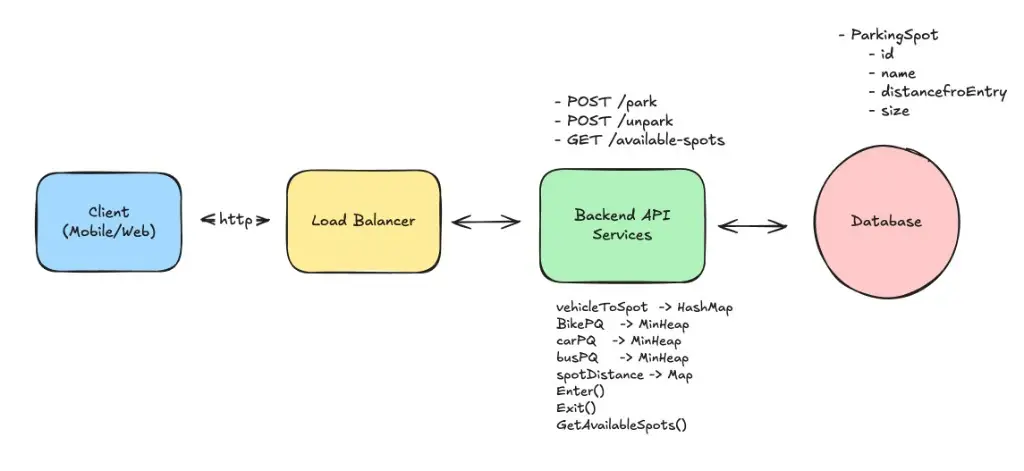
Thinking of the data structure, the immediate idea that comes to my mind is to use a hashmap to store a mapping of vehicleNumbers to the ParkingSpot id.
Naive Approach
another naive approach for storing the parkingspots for me would be to use a queue.
Like say for example we have 100 spots, and we have 50 bikes, 40 cars, and 10 buses right. Then i would consider creating 3 queues, one for bikes, one for cars, and one for buses.
- All open spots (for each vehicle size) would be stored in a queue, as they are filled, they are popped from the queue, and when a vehicle leaves, the spot is added back to the queue.
The time complexity for both of these approaches is O(1), and the space complexity is O(n) where n is the number of spots. (total 100 in our case.)
Better Approach
in the above approach, we are just popping the spots from the queue without any consideration of the distance from the entry.
So what if we could store the spots in a way that the closest spot is always at the front of the queue?
So how to do this?
We can use a min heap to store the spots.
Maintain priority queues for each vihicle size, and assign spot with minimum distance from entry everytime.
The time complexity for this approach is O(log n) but gives best nearest spot everytime, and the space complexity is O(n) where n is the number of spots. (total 100 in our case.)
Pseudo Code
Say we have a list of spots along with their distances from the entrance, and their sizes, so we can create the priority queues for each vehicle size.
We get this list_of_spots from the database we mentioned in Entities section. (ParkingSpot table)
Constructor(list_of_spots):
    vehicleToSpot = {}                     // license -> (size, spotId)
    spotDistance = {}                // spotId -> distanceToEntrance

    bikePQ = MinHeap()
    carPQ  = MinHeap()
    busPQ  = MinHeap()

    for each spot in list_of_spots:
        spotDistance[spot.id] = spot.distanceToEntrance

        if spot.size == BIKE:
            bikePQ.push( (spot.distanceToEntrance, spot.id) )
        else if spot.size == CAR:
            carPQ.push( (spot.distanceToEntrance, spot.id) )
        else:
            busPQ.push( (spot.distanceToEntrance, spot.id) )
Now for the park a vehicle api, we can do the following:
Enter(vehicle_size, license_plate):
    if vehicle_size == BIKE:
        pq = bikePQ
    else if vehicle_size == CAR:
        pq = carPQ
    else:
        pq = busPQ

    if pq.isEmpty():
        return NONE

    (dist, spotId) = pq.pop()                  // allocate best/closest spot
    vehicleToSpot[license_plate] = (vehicle_size, spotId)
    return spotId
Now for the unpark a vehicle api, we can do the following:
Exit(license_plate):
    if license_plate not in vehicleToSpot:
        return FALSE

    (vehicle_size, spotId) = vehicleToSpot[license_plate]
    delete vehicleToSpot[license_plate]

    dist = spotDistance[spotId]            // lookup the stored distance

    if vehicle_size == BIKE:
        bikePQ.push( (dist, spotId) )
    else if vehicle_size == CAR:
        carPQ.push( (dist, spotId) )
    else:
        busPQ.push( (dist, spotId) )

    return TRUE
Now for the get available spots for each vehicle size api, we can do the following:
GetAvailableSpots():
    return { MOTORCYCLE: bikePQ.size(), CAR: carPQ.size(), BUS: busPQ.size() }
Rememeber without vehicleToSpot, the exit would not be possible, as we need to know the spotId to free the spot.
HLD
Thanks for reading! Do subscribe to my newsletter to get notified about new blogs and updates.