SQL vs NoSQL: A Simple Checklist to Choose the Right Database in Interviews
December 18, 2025
You’re in a system design interview and you reach the point where you need to decide how the system will store its data.
“What database would you use, and why?”
This is where everybody starts panicking and guessing.
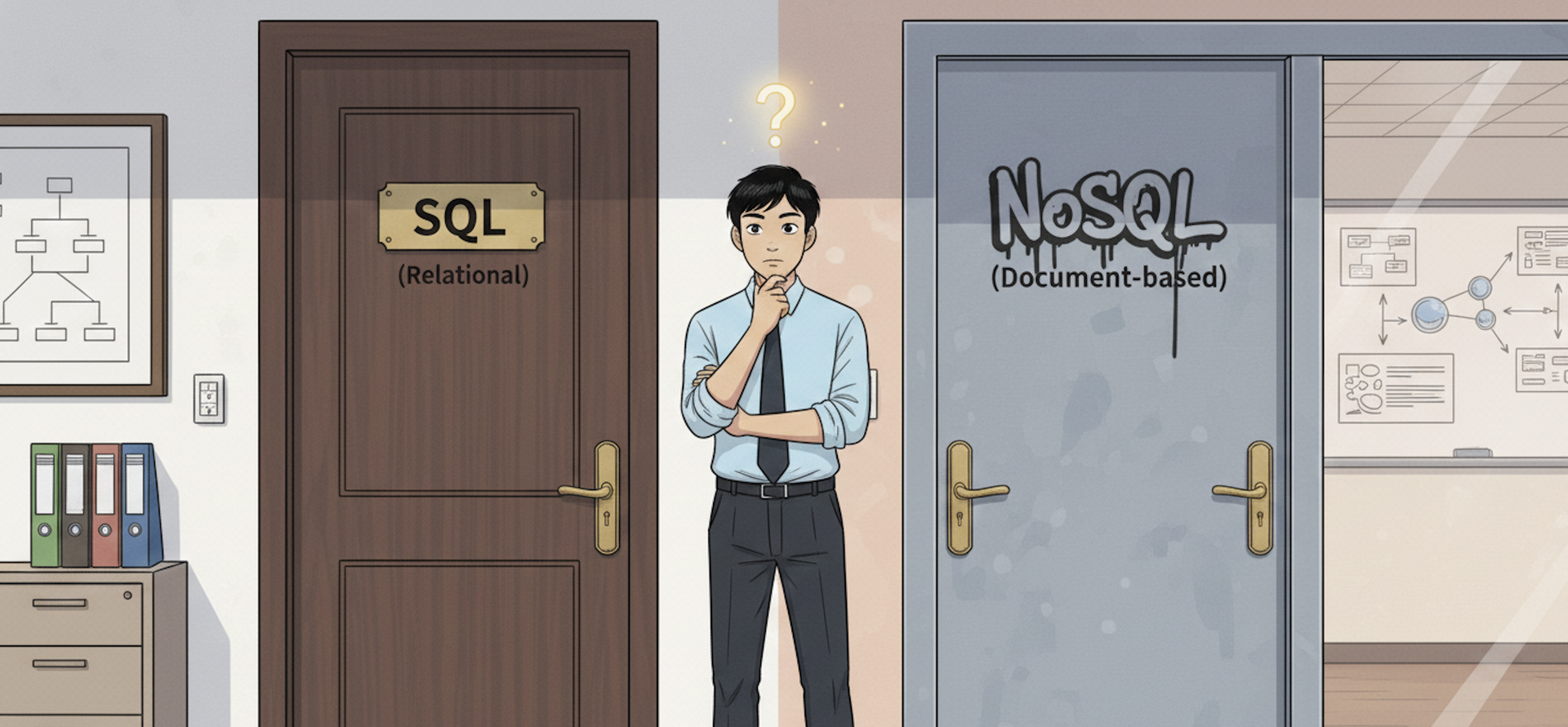
But choosing a database isn’t a SQL vs NoSQL vibe-check. It’s an engineering decision that directly impacts performance, scalability, cost, and how painful your system will be to maintain over time.
Before you design a schema, you need to decide what type of database you’re designing for. That choice shapes everything that follows: how you model data, how you query it, how it scales, and what trade-offs you accept.
There isn’t a single correct database. Different database models exist because they solve different problems well. In a system design interview, what matters most is not the database you choose, but how clearly you justify it.
Understanding when to use relational, document, key-value, or graph databases and why you wouldn’t use them in certain scenarios shows the interviewer that you’re thinking in terms of trade-offs. Great system design isn’t about perfect choices it’s about making clear trade-offs and defending them with requirements.
In this article I will break down the different types of databases and their pros and cons to help you make an informed decision.
There are various factors to consider when selecting a database system.
Here are steps to help you choose the appropriate database:
Understand your data requirements
What kind of data are you storing?
- Analyze the nature of your data, including its structure, volume, and complexity.
- Determine if your data is structured (relational), semistructured (like JSON or XML), or unstructured (e.g., text, images).
- Consider the growth rate of your data and whether it’s transactional or analytical.
Identify your use cases
What kind of queries you run?
- See if your application is read heavy, write heavy, complex queries, realtime analytics, or simple CRUD operations.
Scalability requirements
How will this grow?
- Determine whether you’ll scale up (vertical) or scale out (horizontal), and how well the database supports sharding, read replicas, and failover since not all databases handle horizontal scaling equally.
Data consistency
How correct does it need to be?
- Decide whether your application requires strict ACID (Atomicity, Consistency, Isolation, Durability) compliance or if eventual consistency is acceptable.
Query complexity
How will you be accessing the data?
- Consider what queries you’ll run (simple lookups, joins, aggregations, text search, graph traversals) and whether the database can execute them efficiently with the right indexes and query engine capabilities.
To understand different database types, their use cases, and trade-offs, I’ve curated the table below to show how and when each database should be chosen. There is no one-size-fits-all solution the best database always depends on the unique requirements and constraints of your system.
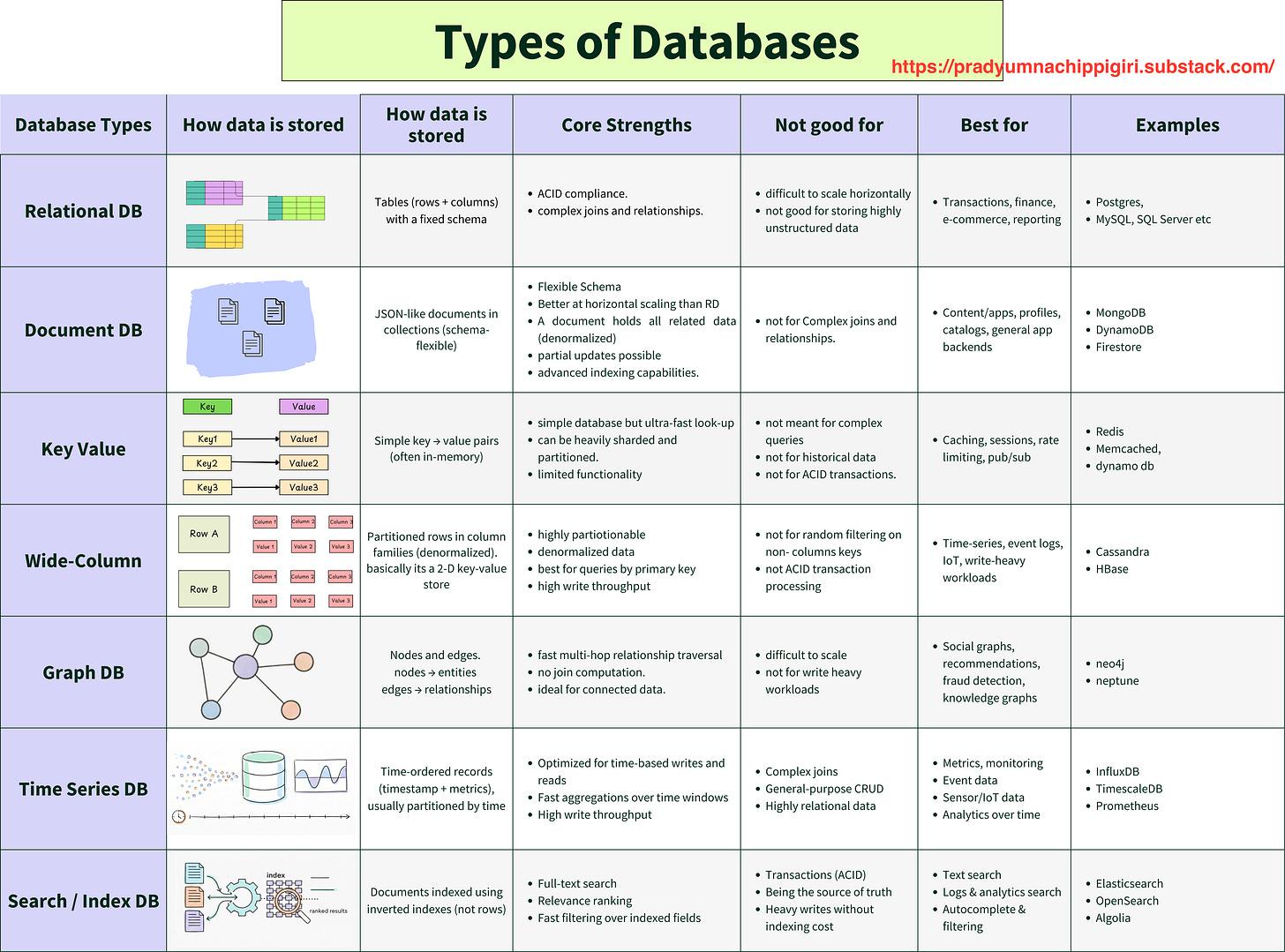
When asked to choose a database in a system design interview, the interviewer isn’t looking for a buzzword or a trendy technology. They’re looking for clear reasoning.
Start with the requirements. Explain how the data is shaped, how it’s accessed, how it grows, and what trade-offs matter most. Then choose a database that fits those constraints and explicitly call out what can be given up.
That’s how you turn SQL vs NoSQL from a panic moment into a confident discussion.
Hope you liked this deep dive and the curated table.
If you liked this article please do Subscribe to my weekly newsletter!
Until then see you in the next one.